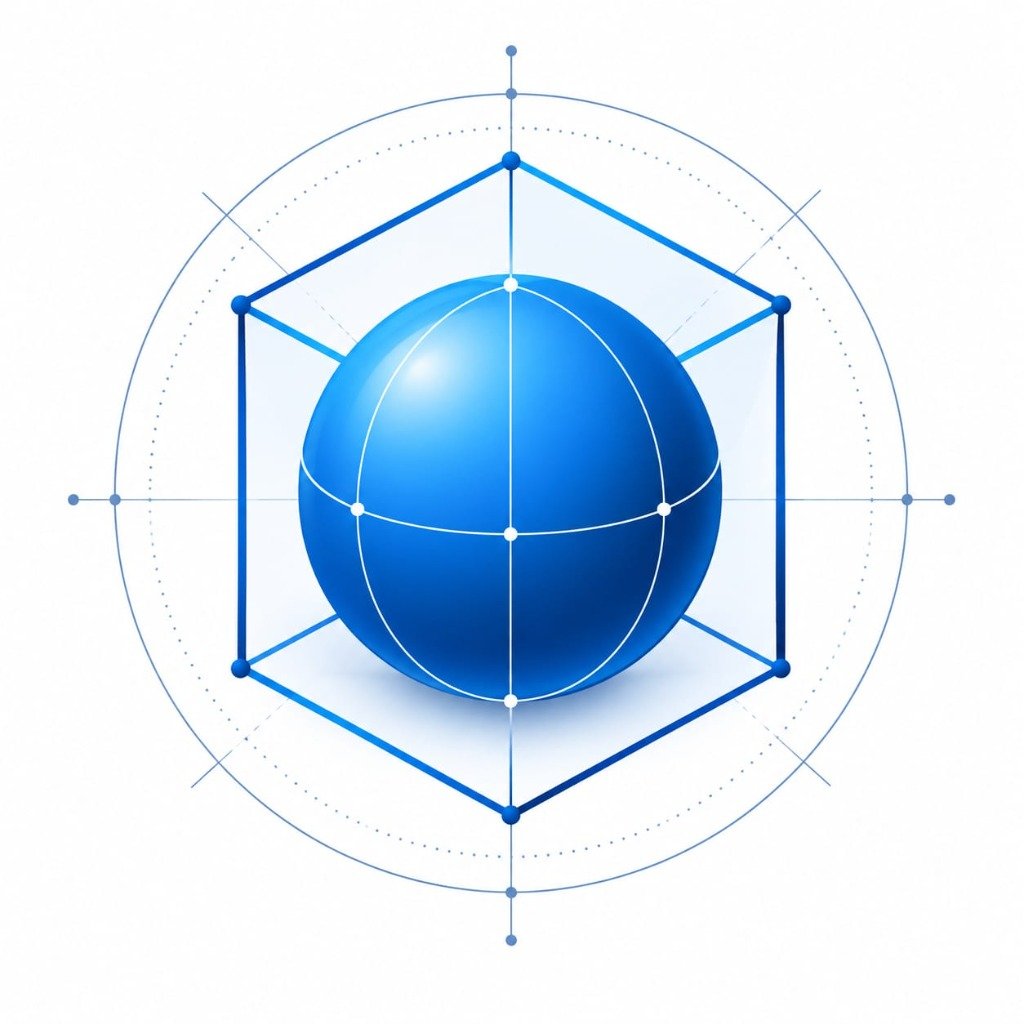
Surface Area Formula Derivation & Meaning
The surface area of a sphere represents the total two-dimensional area of its curved boundary. While calculating volume measures the space inside (\(V = \frac{4}{3}\pi r^3\)), surface area measures the material needed to wrap the sphere.
The surface area is exactly four times the area of a circle with the same radius (\(4 \times \pi r^2\)).
Connection Between Surface Area and Sphere Volume
In calculus, the surface area of a sphere is the first derivative of its volume with respect to radius:
&frac{d}{dr} V = &frac{d}{dr} (&frac43;πr³) = 4πr² = A
Geometrically, as the radius of a sphere increases by an infinitesimal thickness \(dr\), the additional volume added is an extremely thin spherical shell of area \(A\) and thickness \(dr\), meaning \(dV = A \cdot dr\).