
Sphere Surface Area Formula: Proof & Applications

Learn how A = 4πr² calculates the exact exterior surface area of any sphere and its geometric relationship to the circle.
Advertisement
Featured Mathematics Learning Partner
Explore Advanced Geometry & 3D Modeling Tools

The Sphere Surface Area Formula Explained

The total surface area enclosing a three-dimensional sphere is given by:

A = 4 × π × r²
  • A = Total surface area in square units (e.g. cm², m², in²)
  • r = Radius of the sphere
  • π = Mathematical constant Pi (≈ 3.14159)

The Four Circles Principle

An intuitive way to visualize why the constant is 4 is to imagine unwrapping the surface of an orange. If you trace the great circle of the orange onto paper, the peel will completely and evenly cover exactly four circles of that same radius. Thus, Surface Area = 4 × Area of Great Circle = 4 × (πr²).

Worked Example

Find the surface area of a sphere with radius r = 7 cm (approximating π as 22/7):

  1. Write formula: A = 4 × π × r²
  2. Square the radius: 7² = 49 cm²
  3. Multiply by 4: 4 × 49 = 196
  4. Multiply by π: 196 × (22/7) = 28 × 22 = 616 cm²
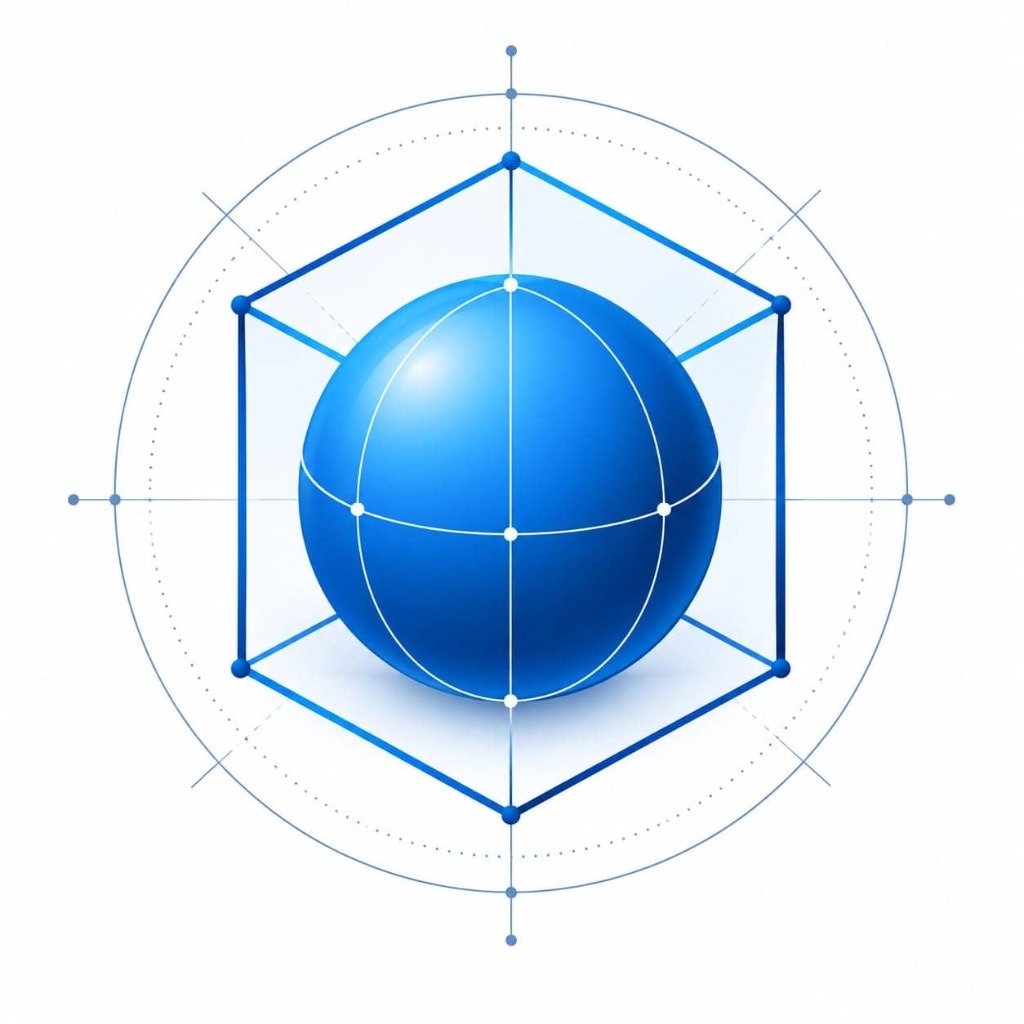
Sphere Volume Formula

Sphere Volume Formula

V = (4/3) × π × r³
Where V = Volume • r = Radius • π ≈ 3.14159265

Essential Mathematical Notation

  • V Volume of the sphere — The three-dimensional space enclosed within the spherical surface, measured in cubic units (e.g., cm³, m³, in³, ft³).
  • r Radius of the sphere — The straight-line distance from the exact center to any point on the outer surface (r = d / 2).
  • π Pi (π) — The mathematical circle constant, approximately 3.14159265 (or 22/7).
  • 4/3 Geometric Constant (4/3) — The rational coefficient derived from spherical calculus integration.
  • r³ Radius Cubed (r³) — The radius multiplied by itself three times (r × r × r), measuring 3D volume.
📂 Topic Archive: Sphere Volume Category →
Sphere Volume Formula →