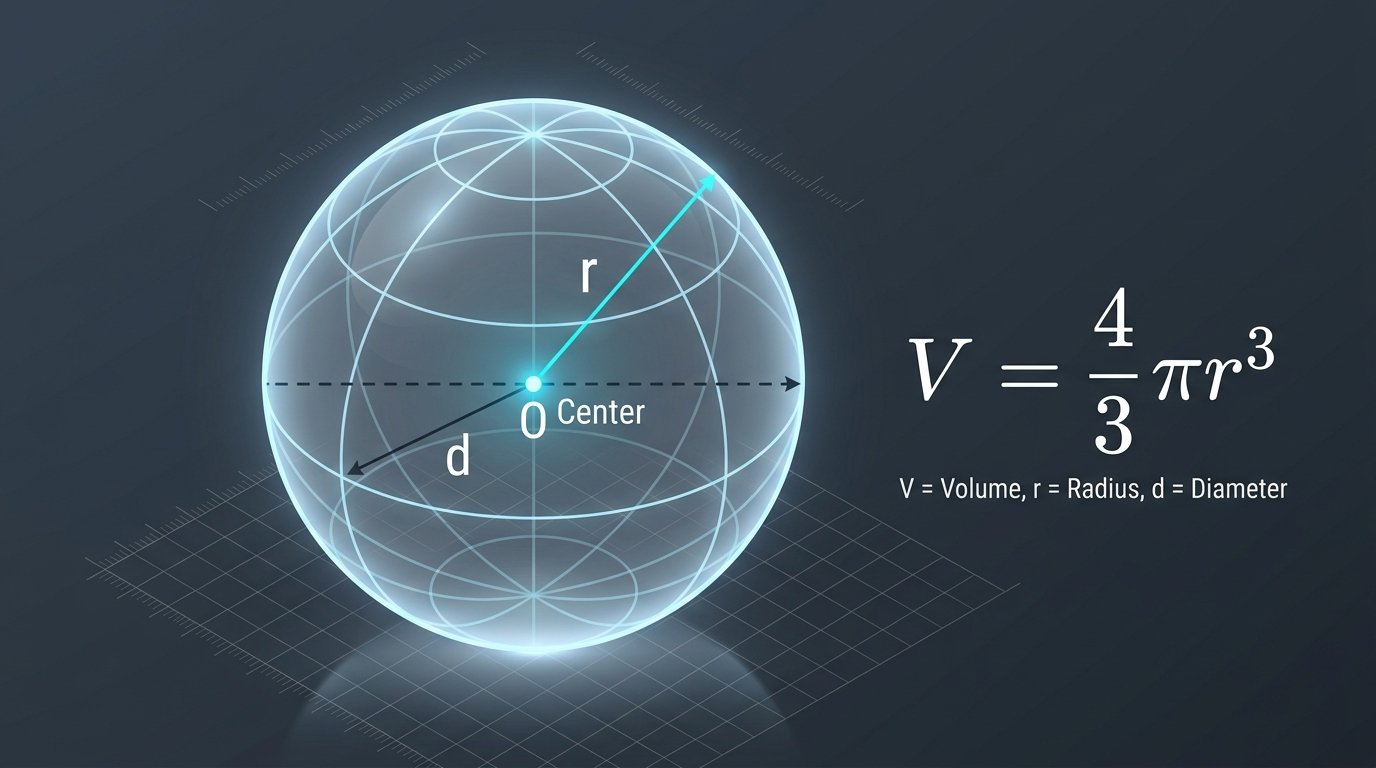
Give me a break! I could not understand why the formula of the volume of a sphere has a 4/3. What was the use of having πr³ on its own? Why is there an extra 4/3, why not just leave it as is? My teacher told me to just memorize it.
I will not just give you the formula of sphere volume; I will show you the derivation of that very 4/3, so that you will remember it forever. I will show you how to avoid getting mixed up between area and volume, and how to simply calculate it given only the diameter in under 10 seconds. Let us dive in.
📑 Table of Contents
- What is a sphere? More than a 3-D circle?
- Main formula everybody searches for
- Sphere volume formula with diameter — An extremely handy trick
- Formulas for hollow sphere and hemisphere
- For what reason 4/3? The real derivation explained in simple terms [most important]
- Finding a sphere's volume step by step
- Example calculations — 3 inch, 4 inch and more
- Volume vs surface area: why we mix up 4/3 πr³ with 4πr²
- Real life applications you never imagined
- 5 common mistakes that get you marks deducted
- Frequently Asked Questions (FAQs)
1. What is a sphere? More than a 3-D circle?
Is a sphere nothing but a 3-D circle? Almost, but not exactly. This is a very common question asked on Google and by students in geometry classrooms worldwide.
A circle is strictly two-dimensional (2-D): it exists only on a flat plane with height and width, enclosing an area. A sphere is three-dimensional (3-D): it extends outward in all physical directions from its center, enclosing volume and holding capacity.
A sphere is defined mathematically as the set of all points in three-dimensional space that are at an equal distance from a central point. That constant distance from the center to any point on the outer boundary is called the radius (r). The straight line traversing through the center from one surface to the opposite is the diameter (d), which always equals 2 × r.
Think of a cricket ball, a basketball, a solid marble, or even our planet Earth. Those are all spheres. A circle drawn on paper has no depth and can hold nothing inside. A sphere possesses depth and physical capacity.

2. Main formula everybody searches for
This is the fundamental mathematical rule defining the volume of a sphere. The exact, universally accepted formula is:
- V = Volume of the sphere (capacity of 3D space enclosed within the boundary).
- r = Radius of the sphere (straight-line distance from center to exterior).
- π (pi) ≈ 3.14159265... an unchanging numerical constant representing the ratio of a circle's circumference to its diameter. In practical school calculations,
3.14or22/7is commonly used.
When we cube the radius (r × r × r) and multiply by π and 4/3, we obtain the internal capacity of the sphere. For example, this value tells you precisely how much water a spherical glass container can hold or how much air is needed to inflate a basketball.
3. Sphere volume formula with diameter — An extremely handy trick
Here is a big missing piece that confuses many students: in laboratory experiments, machining workshops, and textbook exam questions, you are frequently given the diameter (d) rather than the radius. Because calipers can only clamp across the outside of a physical ball, measuring diameter is often the only practical option.
Recall that Diameter = 2 × Radius, which means:
Substituting r = d / 2 directly into our primary volume equation:
$$V = \frac{4}{3}\pi \left(\frac{d}{2}\right)^3$$
Expanding the cube gives (d/2)³ = d³ / 8:
$$V = \frac{4}{3}\pi \times \frac{d^3}{8}$$
Simplifying the fraction 4/3 × 1/8 = 4/24 = 1/6:
Speed Example: Suppose you have a ball with a diameter of 10 cm.
Using the shortcut: V = (1/6) × 3.14159 × 10³ = (1/6) × 3141.59 ≈ 523.60 cm³ (or 523.33 cm³ if rounding π to 3.14).
This is much faster because you never have to divide by 2 first and then cube a decimal fraction. Teachers rarely emphasize this shortcut, but memorizing V = πd³ / 6 will save you valuable time and prevent arithmetic errors during timed examinations.
4. Formulas for hollow sphere and hemisphere
What if the sphere is not solid throughout? What if it is hollow inside, like a rubber tennis ball, a ping pong ball, or a spherical storage tank?
Volume of a Hollow Sphere (Spherical Shell)
A hollow sphere has an outer radius R and an inner hollow core radius r. To calculate the material volume of the shell, subtract the volume of the inner empty sphere from the volume of the outer full sphere:
Notice that the formula uses (R³ - r³), which is NOT the same as (R - r)³! You must cube both radii independently before subtracting them.
Volume of a Hemisphere
A hemisphere is created by slicing a perfect sphere exactly in half through its geometric center. Because it is half of a sphere, we simply divide the primary volume formula by 2:
When dealing with hemispheres, keep in mind surface area differences:
- Curved Dome Area: 2\pi r² (half of 4πr²)
- Flat Base Disc Area: \pi r² (standard circle area)
- Total Surface Area (Solid Hemisphere): 2\pi r² + \pi r² = \mathbf{3\pi r^2}
5. For what reason 4/3? The real derivation explained in simple terms [most important]
Alright, this is the most important part of this guide. Why does the volume of a sphere contain the fraction 4/3? According to Google search data, this is one of the most frequently asked mathematics questions by students worldwide.
There are two primary ways to understand this proof: the intuitive geometric approach discovered by Archimedes 2,200 years ago, and the modern calculus integration method. The Archimedes approach is pure genius and remarkably simple to remember.
The Archimedes Cylinder-Sphere-Cone Proof
Archimedes discovered a breathtaking relationship connecting three fundamental three-dimensional shapes: a cylinder, a sphere, and a cone.
Imagine a cylinder that snugly encloses a sphere of radius r. This cylinder has a base radius of r and a total height equal to the sphere's diameter, so h = 2r. Next, imagine an inverted cone placed inside this exact same cylinder, sharing the same base radius r and height h = 2r.

Archimedes established that:
Let us write down the known volumes using our cylinder and cone formulas with h = 2r:
- Volume of the Cylinder:
$$V_{\text{cylinder}} = \pi r^2 h = \pi r^2(2r) = 2\pi r^3 = \frac{6}{3}\pi r^3$$ - Volume of the Cone:
$$V_{\text{cone}} = \frac{1}{3}\pi r^2 h = \frac{1}{3}\pi r^2(2r) = \frac{2}{3}\pi r^3$$ - Solving for the Sphere Volume:
$$V_{\text{cylinder}} = V_{\text{sphere}} + V_{\text{cone}}$$ $$2\pi r^3 = V_{\text{sphere}} + \frac{2}{3}\pi r^3$$ $$V_{\text{sphere}} = 2\pi r^3 - \frac{2}{3}\pi r^3 = \left(2 - \frac{2}{3}\right)\pi r^3 = \mathbf{\frac{4}{3}\pi r^3}$$
That is where the 4/3 comes from! It is not an arbitrary coefficient. It is the remaining space when you subtract the volume of a cone (2/3) from the bounding cylinder (2). Archimedes was so proud of this mathematical discovery that he requested a cylinder circumscribing a sphere be carved upon his tombstone.
The Calculus Integration Approach (Disc Method)
For high school and university students learning calculus, the sphere can be sliced into an infinite stack of thin horizontal circular discs along the x-axis, running from x = -r to x = +r.
By the Pythagorean theorem, the radius y of any cross-sectional disc at distance x from the center satisfies x² + y² = r², which means y² = r² - x².
The area of each thin slice is A(x) = \pi y² = \pi(r² - x²). Integrating with respect to x:
$$V = \int_{-r}^{r} \pi\left(r^2 - x^2\right)\,dx = 2\pi \int_{0}^{r} \left(r^2 - x^2\right)\,dx$$
$$V = 2\pi \left[ r^2 x - \frac{x^3}{3} \right]_0^r = 2\pi \left( r^3 - \frac{r^3}{3} \right) = 2\pi \left(\frac{2}{3}r^3\right) = \mathbf{\frac{4}{3}\pi r^3}$$
Notice that \left(1 - \frac{1}{3}\right) = \frac{2}{3}, and multiplying by the symmetry factor of 2 produces \mathbf{\frac{4}{3}} every single time.
6. Finding a sphere's volume step by step
Let us make this super practical. When solving any sphere volume problem on homework, tests, or real-world projects, follow this foolproof 5-step sequence:

-
Step 1: Find the radius (r).
Check your problem carefully. If given the diameter, divide it by 2 (r = d / 2). If given radius, use it directly. -
Step 2: Cube the radius (r³).
Multiply the radius by itself twice (r × r × r). Never multiply by 3! -
Step 3: Multiply by π.
Multiply your cubed radius by π (use 3.14159, or 22/7 if the radius is a multiple of 7). -
Step 4: Multiply by 4, then divide by 3 (or multiply by 4/3).
Multiply the result by 4 and divide by 3 to apply the geometric constant. -
Step 5: Attach the correct cubic unit.
Ensure your answer ends in cubic units (e.g., cm³, m³, in³, or ft³).
7. Example calculations — 3 inch, 4 inch and more
Let us work through exact calculations for common problems students search for every day.
Given: Radius r = 3\text{ inches}, \pi \approx 3.14159265
- Write the formula: V = \frac{4}{3}\pi r^3
- Cube the radius: 3^3 = 3 \times 3 \times 3 = 27\text{ in}^3
- Substitute into formula: V = \frac{4}{3} \times \pi \times 27
- Simplify: \frac{4 \times 27}{3}\pi = 4 \times 9\pi = 36\pi\text{ in}^3\quad\text{(Exact Answer)}
- Decimal calculation: 36 \times 3.14159265 \approx \mathbf{113.10\text{ cubic inches}}
Answer: The volume of a 3-inch radius sphere is exactly 36π in³, or approximately 113.10 cubic inches.
Given: Radius r = 4\text{ inches}, \pi \approx 3.14159265
- Write the formula: V = \frac{4}{3}\pi r^3
- Cube the radius: 4^3 = 4 \times 4 \times 4 = 64\text{ in}^3
- Substitute into formula: V = \frac{4}{3} \times \pi \times 64 = \frac{256}{3}\pi\text{ in}^3
- Decimal calculation: \frac{256}{3} \times 3.14159265 \approx 85.333 \times 3.14159265 \approx \mathbf{268.08\text{ cubic inches}}
Answer: The volume of a 4-inch radius sphere is approximately 268.08 cubic inches.
Given: Diameter d = 14\text{ cm}. Notice this provides the diameter, so our radius is r = 14 / 2 = 7\text{ cm}.
Because the radius (7) is an exact multiple of 7, using \pi = \frac{22}{7} makes calculation effortless:
- Find radius: r = 7\text{ cm}
- Cube radius: 7^3 = 7 \times 7 \times 7 = 343\text{ cm}^3
- Apply formula: V = \frac{4}{3} \times \frac{22}{7} \times 343
- Cancel 7 into 343: 343 / 7 = 49 \implies V = \frac{4 \times 22 \times 49}{3}
- Multiply numerator: 88 \times 49 = 4312
- Divide by 3: \frac{4312}{3} = \mathbf{1437.33\text{ cm}^3}
Answer: The ball has a volume of approximately 1,437.33 cm³ (or 1.437 liters of liquid capacity).
Quick Reference Sphere Volume Table
Below is a quick reference table showing exact formulas and computed volumes for spheres with common radii:
| Radius (r) | Diameter (d) | Exact Form (π) | Volume (Decimal) | Fluid Capacity |
|---|---|---|---|---|
| 1 cm | 2 cm | (4/3)π cm³ | 4.19 cm³ | 4.19 mL |
| 2 cm | 4 cm | (32/3)π cm³ | 33.51 cm³ | 33.51 mL |
| 3 cm | 6 cm | 36π cm³ | 113.10 cm³ | 113.10 mL |
| 5 cm | 10 cm | (500/3)π cm³ | 523.60 cm³ | 523.60 mL |
| 7 cm | 14 cm | (1372/3)π cm³ | 1,436.76 cm³ | 1.437 Liters |
| 10 cm | 20 cm | (4000/3)π cm³ | 4,188.79 cm³ | 4.189 Liters |
| 3 inches | 6 inches | 36π in³ | 113.10 in³ | 0.490 US Gallons |
| 4 inches | 8 inches | (256/3)π in³ | 268.08 in³ | 1.161 US Gallons |
8. Volume vs surface area: why we mix up 4/3 πr³ with 4πr²
Another classic question that troubles students is: "What is 4πr² used for, and why do people always confuse 4πr² with 4/3πr³?"
Both formulas feature the number 4, both contain π, and both have the radius r. But they measure fundamentally different physical properties:

- Surface Area (4\pi r^2): The amount of 2-dimensional area covering the outside skin of the sphere. Think of the amount of wrapping paper required to neatly gift-wrap a spherical ball. Measured in square units (cm², in²).
- Volume (\frac{4}{3}\pi r^3): The amount of 3-dimensional physical space or liquid contained inside the sphere. Think of the volume of water needed to fill the ball. Measured in cubic units (cm³, in³).
Look at the exponent attached to r:
- Power of 1 (r^1) = 1-Dimensional Length: Perimeter or circumference (e.g., C = 2\pi r). Measured in linear units (cm, in).
- Power of 2 (r^2) = 2-Dimensional Area: Flat surface coverage (e.g., A = 4\pi r^2). Measured in square units (cm², in²).
- Power of 3 (r^3) = 3-Dimensional Volume: Capacity and solid content (e.g., V = \frac{4}{3}\pi r^3). Measured in cubic units (cm³, in³).
What about 2πr? Many people ask: "What is the formula 2πr?" That formula belongs to a flat 2D circle's circumference! It does not describe a sphere's surface area or volume at all.
9. Real life applications you never imagined
Why do we study sphere volume anyway? Does anyone actually use this formula outside of a classroom? The answer is an overwhelming yes. Spherical geometry governs critical engineering, medicine, and astrophysical systems across the universe:

-
1. Sports Ball Engineering:
How much compressed air is required to inflate a soccer ball, basketball, or volleyball to official regulation standards? Sports equipment manufacturers use the volume formula to calibrate internal air bladder volume and pressure tolerances. -
2. Space Exploration & NASA:
Why does NASA use just 15 decimal digits of π (3.141592653589793)? Because 15 digits of π are sufficient to compute the volume and circumference of the entire observable universe with an accuracy within the width of a single hydrogen atom! Astrophysicists routinely apply the formula to determine the volume, density, and mass of planets, moons, and neutron stars. -
3. Medicine & Pharmacology:
Pharmacists and biomedical engineers calculate the volume of spherical pills and drug delivery liposomes. The volume determines exact medication dosage, while the surface-area-to-volume ratio dictates how rapidly the pill dissolves in the patient's bloodstream. -
4. Culinary Arts & Food Production:
How much ice cream is contained in a spherical scoop with a 2-inch diameter? Bakeries, ice cream brands, and molecular gastronomy chefs rely on spherical volumes for recipe consistency and ingredient portioning. -
5. Jewelry & Metallurgy:
Jewelers casting solid spherical gold beads or steel ball bearings compute the metal volume first. By multiplying volume by the metal's density (\text{Mass} = \text{Density} \times \text{Volume}), they can predict the exact weight and material cost before casting.
10. 5 common mistakes that get you marks deducted
Over 80% of student marks lost on sphere volume exam questions stem from these five preventable mistakes:
If an exam question states "A sphere has a diameter of 10 cm" and you plug 10 directly into r^3, you get 1,000 instead of 125 (5^3). Your resulting volume will be 8 times too large (since 2^3 = 8)! Always verify whether the question gave you a radius or a diameter.
Students under exam pressure frequently write r \times 3 instead of r \times r \times r. For example, if r = 4, multiplying by 3 gives 12, whereas cubing gives 4 \times 4 \times 4 = 64. That is a massive error!
Always double-check what the question asks for: volume requires the cubic power r^3 with 4/3, while surface area requires the squared power r^2 with 4.
If the radius is an integer multiple of 7 (such as 7, 14, 21), use \pi = 22/7 for convenient fraction cancellation. If the problem specifies 3.14 or 3.14159, keep full precision until the final step to avoid rounding drift.
Volume represents 3D space, so it must always end in cubic units (\text{cm}^3, \text{m}^3, \text{in}^3). Writing cm (linear length) or cm² (surface area) will cost you full marks for unit precision.
11. Frequently Asked Questions
Below are clear, direct answers to the most common questions regarding the sphere volume formula:
Why is there a 4/3 in the sphere volume formula?
The 4/3 coefficient is derived from both geometry and calculus. Geometrically, Archimedes demonstrated that a sphere inscribed inside a cylinder has exactly 2/3 of the cylinder's volume, which equals the cylinder's volume minus an inscribed cone (2 - 2/3 = 4/3). In calculus, integrating thin cross-sectional circular discs of area π(r² - x²) from -r to +r naturally produces the factor of 4/3 when evaluating the antiderivative [r²x - x³/3].
How do you find the volume of a sphere with diameter?
To calculate volume directly from diameter (d), you can use the shortcut formula V = (1/6) × π × d³. This is derived by substituting r = d/2 into V = (4/3)πr³, giving (4/3)π(d³/8) = (1/6)πd³. Alternatively, divide the diameter by 2 to get the radius, then use the standard formula V = (4/3)πr³.
What is the difference between sphere volume and surface area?
Surface area (A = 4πr²) measures the two-dimensional outer shell or wrapping of the sphere in square units (cm², in²). Volume (V = 4/3 πr³) measures the three-dimensional space or capacity inside the sphere in cubic units (cm³, in³, liters). A simple rule of thumb: area always has r² (2D), while volume always has r³ (3D).
Why does NASA only use 15 digits of pi?
NASA's Jet Propulsion Laboratory uses 15 decimal digits of pi (3.141592653589793) because it provides astronomical precision. At a distance of 12.5 billion miles (the Voyager 1 spacecraft), using 15 digits of pi introduces an error of less than 1.5 inches in the circumference of that massive orbit. When calculating the volume of the observable universe, 15 digits yields an accuracy within the diameter of a single hydrogen atom.
Does a sphere have any flat faces, edges, or vertices?
No. A sphere is a completely smooth, continuous 3-dimensional curved solid. In Euclidean geometry, a sphere has 0 flat polygonal faces, 0 straight edges, and 0 vertices (corners). It consists of exactly one unbroken curved surface where every single point is equidistant from the geometric center.
Need to Calculate Sphere Volume Instantly?
Use our free, interactive Sphere Volume Calculator. Enter radius or diameter in mm, cm, m, in, or ft to get step-by-step substitution and instant results.
Open Sphere Volume Calculator →