Sphere Volume Formula With Examples: 5 Progressive Practice Scenarios

Five progressive examples ranging from basic integers to decimals, fractions, and diameter-based problems.
Advertisement
Featured Mathematics Learning Partner
Explore Advanced Geometry & 3D Modeling Tools

Five Graded Worked Examples

The best way to solidify your grasp of spherical geometry is through progressive problem-solving.

Example 1: Small Integer Radius (r = 3 cm)

V = 4/3 × π × 3³ = 4/3 × π × 27 = 36π ≈ 113.10 cm³

Example 2: Decimal Radius (r = 2.5 m)

2.5³ = 15.625 → V = 4/3 × π × 15.625 = 20.833π ≈ 65.45 m³

Example 3: Given Diameter (d = 14 cm, using π = 22/7)

r = 7 cm → V = 4/3 × (22/7) × 7³ = 4/3 × 22 × 49 = 4312 / 3 ≈ 1437.33 cm³

Example 4: Hollow Shell Sphere

Outer radius R = 5 cm, inner cavity r = 4 cm. Volume of material = 4/3 π (5³ - 4³) = 4/3 π (125 - 64) = 4/3 π (61) ≈ 255.52 cm³

Example 5: Volume in Terms of Pi

Radius r = 9 units: V = 4/3 × π × 729 = 972π cubic units.

Sphere Volume Formula

Sphere Volume Formula

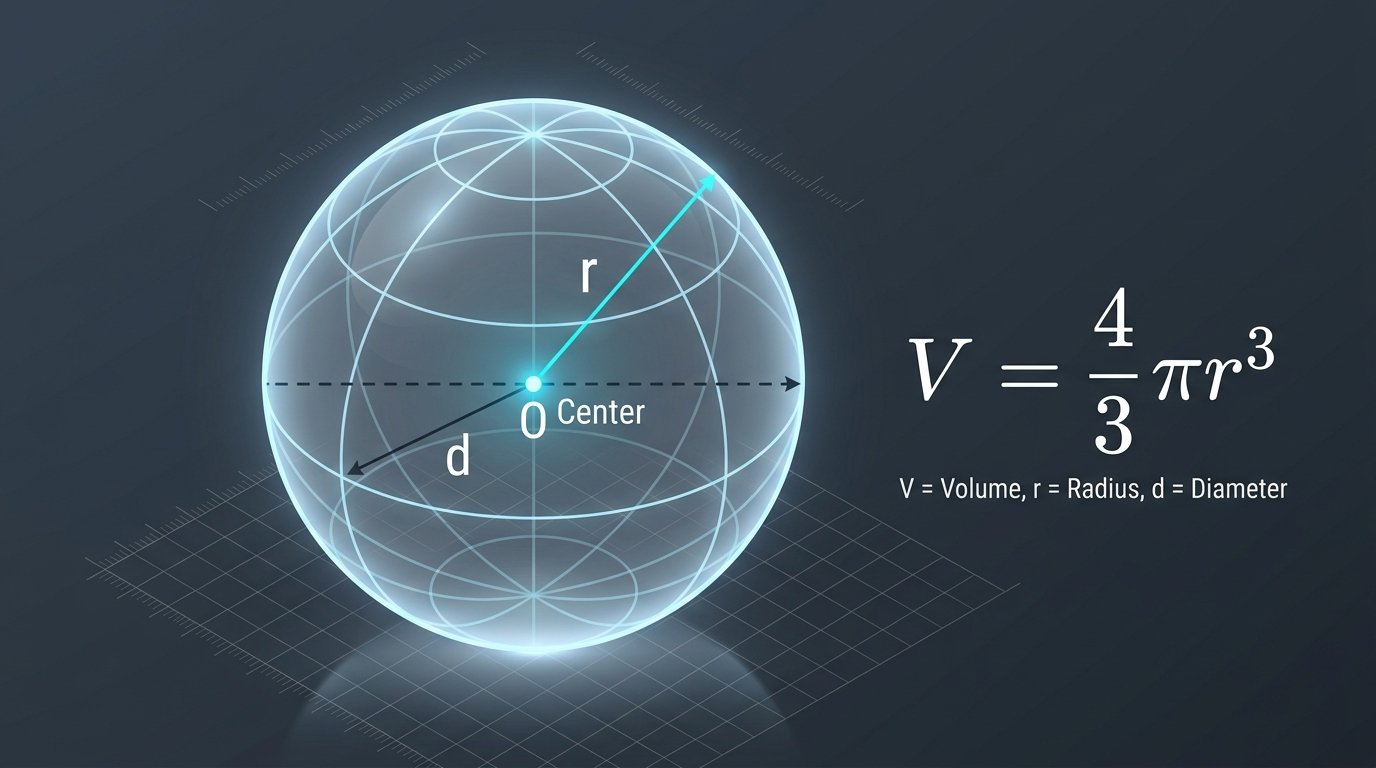
V = (4/3) × π × r³
Where V = Volume • r = Radius • π ≈ 3.14159265

Essential Mathematical Notation

  • V Volume of the sphere — The three-dimensional space enclosed within the spherical surface, measured in cubic units (e.g., cm³, m³, in³, ft³).
  • r Radius of the sphere — The straight-line distance from the exact center to any point on the outer surface (r = d / 2).
  • π Pi (π) — The mathematical circle constant, approximately 3.14159265 (or 22/7).
  • 4/3 Geometric Constant (4/3) — The rational coefficient derived from spherical calculus integration.
  • r³ Radius Cubed (r³) — The radius multiplied by itself three times (r × r × r), measuring 3D volume.
📂 Topic Archive: Math Examples Category →
Sphere Volume Formula →