
Sphere Volume Formula Using Radius: Deep Dive into the r³ Exponent

Why does radius appear to the third power? Understand the cubic scaling law and how doubling the radius multiplies volume by 8.
Advertisement
Featured Mathematics Learning Partner
Explore Advanced Geometry & 3D Modeling Tools

Understanding the Power of r³

In the formula V = 4/3 π r³, the radius is raised to the third power (cubed). This property leads to a fundamental principle of 3D geometry known as the Square-Cube Law.

The Scaling Multiplier

When you scale the radius of a sphere by a factor of k, the volume changes by k³:

  • If you double the radius (k = 2), the volume increases by 2³ = 8 times.
  • If you triple the radius (k = 3), the volume increases by 3³ = 27 times.
  • If you halve the radius (k = 0.5), the volume drops to (1/2)³ = 1/8th of the original volume.
Real-World ApplicationBall Bearings Scaling

A bearing with radius 2 mm has volume: V ≈ 33.51 mm³.
A bearing with radius 4 mm has volume: V ≈ 268.08 mm³.
Notice: 268.08 / 33.51 = 8.00!
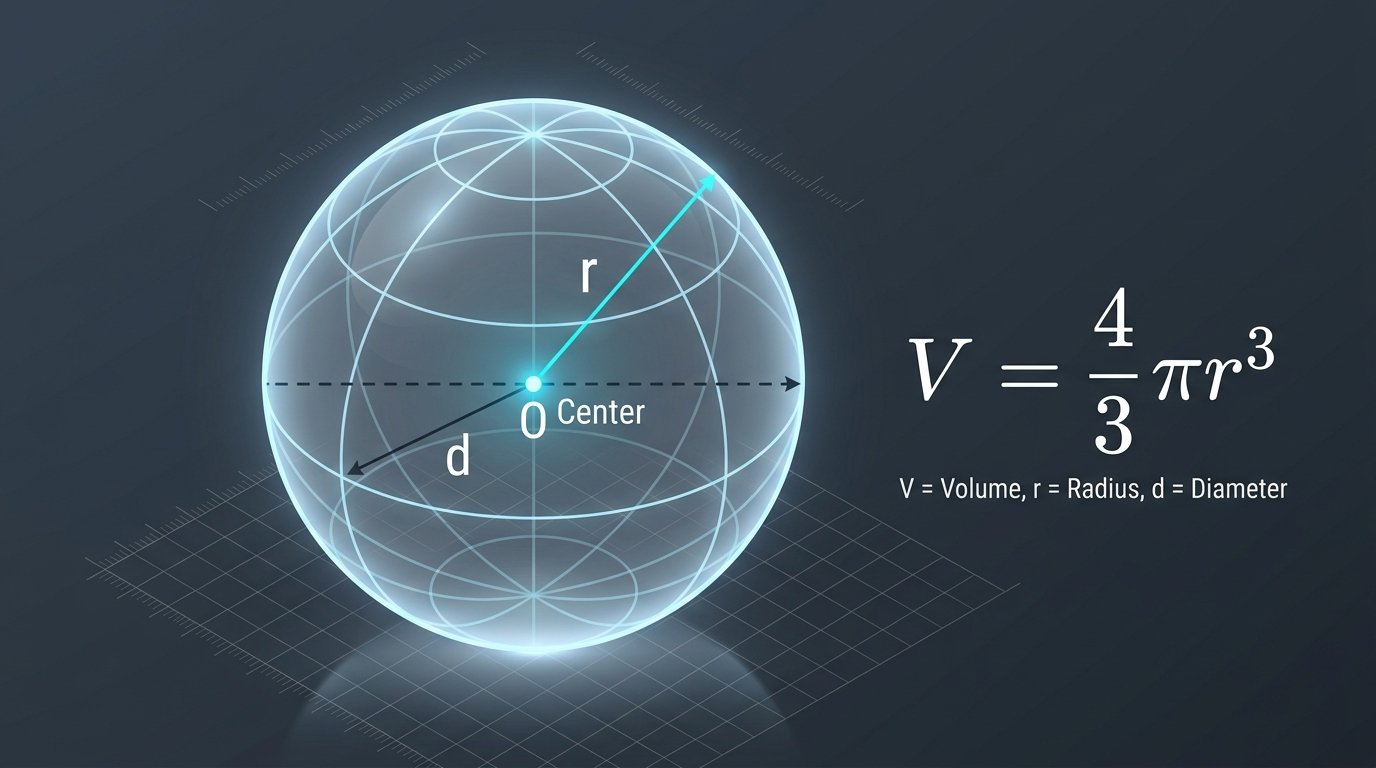
Sphere Volume Formula

Sphere Volume Formula

V = (4/3) × π × r³
Where V = Volume • r = Radius • π ≈ 3.14159265

Essential Mathematical Notation

  • V Volume of the sphere — The three-dimensional space enclosed within the spherical surface, measured in cubic units (e.g., cm³, m³, in³, ft³).
  • r Radius of the sphere — The straight-line distance from the exact center to any point on the outer surface (r = d / 2).
  • π Pi (π) — The mathematical circle constant, approximately 3.14159265 (or 22/7).
  • 4/3 Geometric Constant (4/3) — The rational coefficient derived from spherical calculus integration.
  • r³ Radius Cubed (r³) — The radius multiplied by itself three times (r × r × r), measuring 3D volume.
📂 Topic Archive: Sphere Volume Category →
Sphere Volume Formula →