
What Is the Formula for the Volume of a Sphere? Historical Origins & Logic

Explore the historical discovery by Archimedes of Syracuse and the geometric intuition connecting spheres, cones, and cylinders.
Advertisement
Featured Mathematics Learning Partner
Explore Advanced Geometry & 3D Modeling Tools

The Story Behind V = 4/3πr³

Over 2,200 years ago, the Greek mathematician Archimedes of Syracuse (c. 287 – c. 212 BC) derived the volume of a sphere without modern algebra or calculus. He considered this theorem his crowning achievement, requesting that a sphere inscribed in a cylinder be engraved upon his tombstone.

Archimedes' Mechanical Method

Archimedes balanced geometric solids on an imaginary lever scale. He proved that if you take a sphere and a cone of equal radius and height, their combined weights balance a cylinder on the other side of the fulcrum.

Volume(Cone) + Volume(Sphere) = Volume(Cylinder)

Since Volume(Cone) = 1/3 π r² (2r) = 2/3 π r³, and Volume(Cylinder) = π r² (2r) = 2 π r³:

Volume(Sphere) = 2 π r³ - 2/3 π r³ = 4/3 π r³.
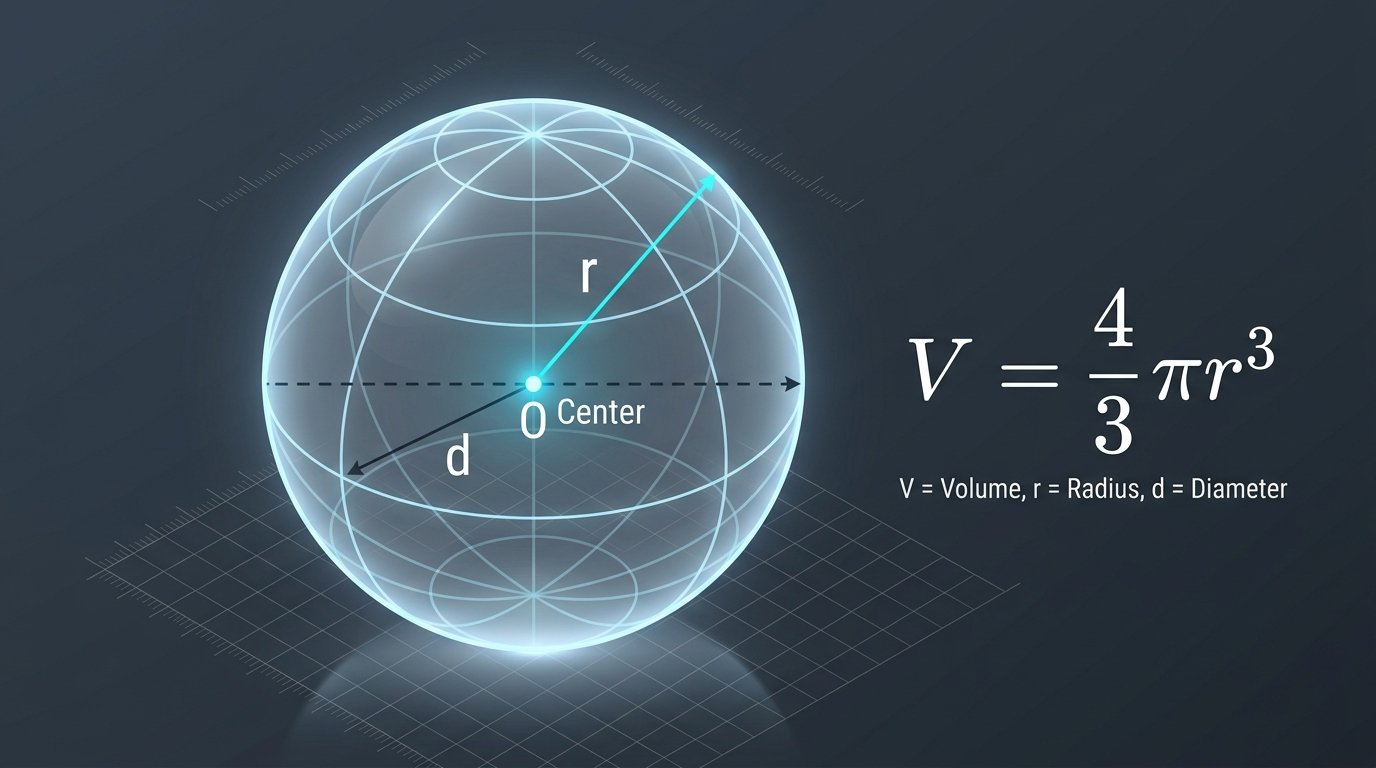
Sphere Volume Formula

Sphere Volume Formula

V = (4/3) × π × r³
Where V = Volume • r = Radius • π ≈ 3.14159265

Essential Mathematical Notation

  • V Volume of the sphere — The three-dimensional space enclosed within the spherical surface, measured in cubic units (e.g., cm³, m³, in³, ft³).
  • r Radius of the sphere — The straight-line distance from the exact center to any point on the outer surface (r = d / 2).
  • π Pi (π) — The mathematical circle constant, approximately 3.14159265 (or 22/7).
  • 4/3 Geometric Constant (4/3) — The rational coefficient derived from spherical calculus integration.
  • r³ Radius Cubed (r³) — The radius multiplied by itself three times (r × r × r), measuring 3D volume.
📂 Topic Archive: Sphere Volume Category →
Sphere Volume Formula →