
Sphere Volume Using Pi: 3.14 vs 22/7 vs Exact Terms of π

Understand when to keep π in your final answer and how different approximations alter precision in geometry tests.
Advertisement
Featured Mathematics Learning Partner
Explore Advanced Geometry & 3D Modeling Tools

Handling Pi in Sphere Calculations

Teachers and curriculum standards use three primary conventions for Pi:

  • Exact Answer in Terms of π: Leave π as a symbol (e.g. V = 36π cm³). Preferred in pure algebra and calculus.
  • Decimal Approximation (π ≈ 3.14 or 3.1416): Multiply through to round to 2 decimal places.
  • Fractional Approximation (π ≈ 22/7): Used when radius is a multiple of 7 to simplify cross-cancellation.
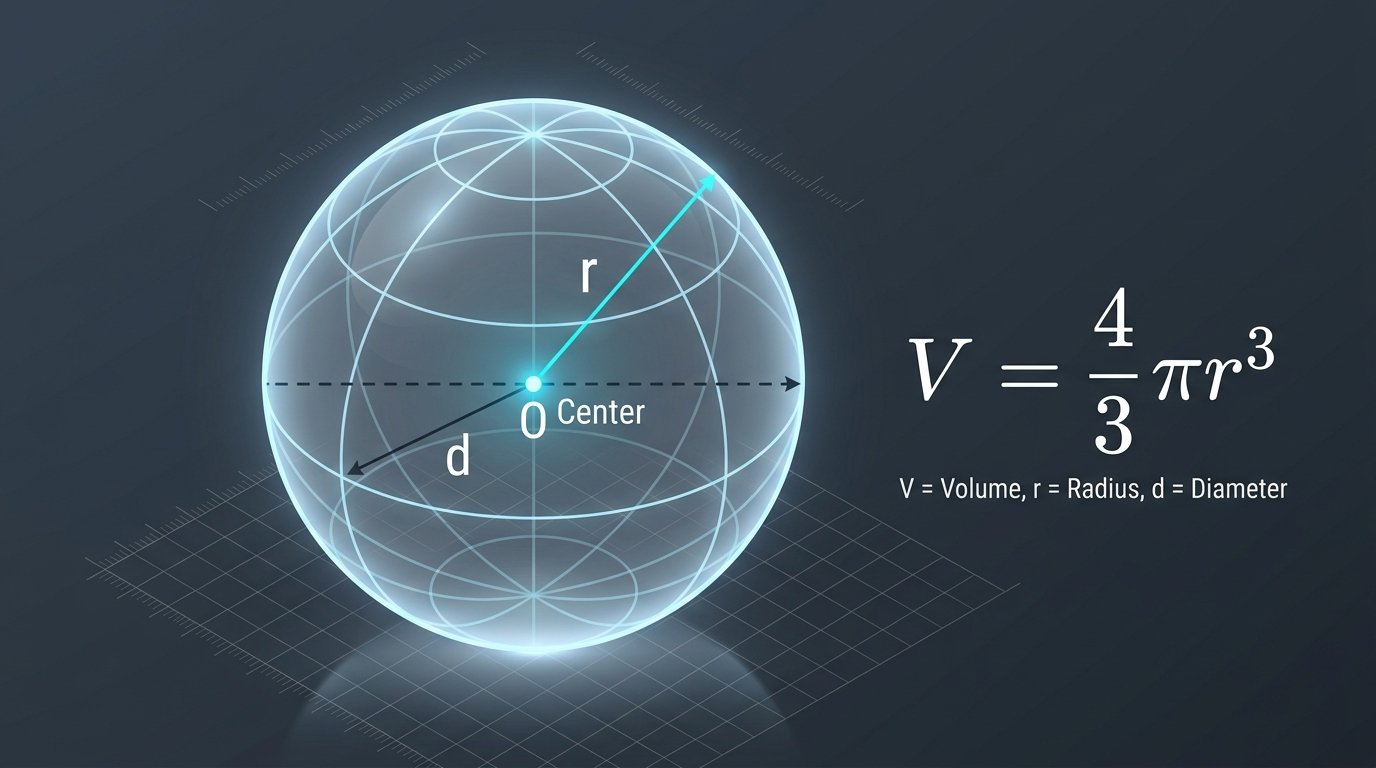
Sphere Volume Formula

Sphere Volume Formula

V = (4/3) × π × r³
Where V = Volume • r = Radius • π ≈ 3.14159265

Essential Mathematical Notation

  • V Volume of the sphere — The three-dimensional space enclosed within the spherical surface, measured in cubic units (e.g., cm³, m³, in³, ft³).
  • r Radius of the sphere — The straight-line distance from the exact center to any point on the outer surface (r = d / 2).
  • π Pi (π) — The mathematical circle constant, approximately 3.14159265 (or 22/7).
  • 4/3 Geometric Constant (4/3) — The rational coefficient derived from spherical calculus integration.
  • r³ Radius Cubed (r³) — The radius multiplied by itself three times (r × r × r), measuring 3D volume.
📂 Topic Archive: Sphere Volume Category →
Sphere Volume Formula →