
Why Is the Sphere Volume Formula 4/3πr³? Intuitive Calculus Explanation

Unpack the mathematical intuition: decompose a sphere into thousands of microscopic pyramids with bases on the surface.
Advertisement
Featured Mathematics Learning Partner
Explore Advanced Geometry & 3D Modeling Tools

Visualizing Microscopic Pyramids

While calculus integration provides formal proof, there is a brilliant geometric intuition that makes 4/3 π r³ instantly obvious:

The Pyramid Decomposition

Imagine packing the interior of a sphere with thousands of tiny pyramids, each having its apex at the center of the sphere and its base on the spherical surface.

  1. The volume of any pyramid is (1/3) × base_area × height.
  2. For every one of our tiny pyramids, the height is the radius r of the sphere!
  3. Summing all pyramid volumes: Total Volume = 1/3 × (Sum of all base areas) × r.
  4. The sum of all base areas equals the surface area of the sphere: 4πr²!
  5. Therefore: V = (1/3) × (4πr²) × r = 4/3 π r³!
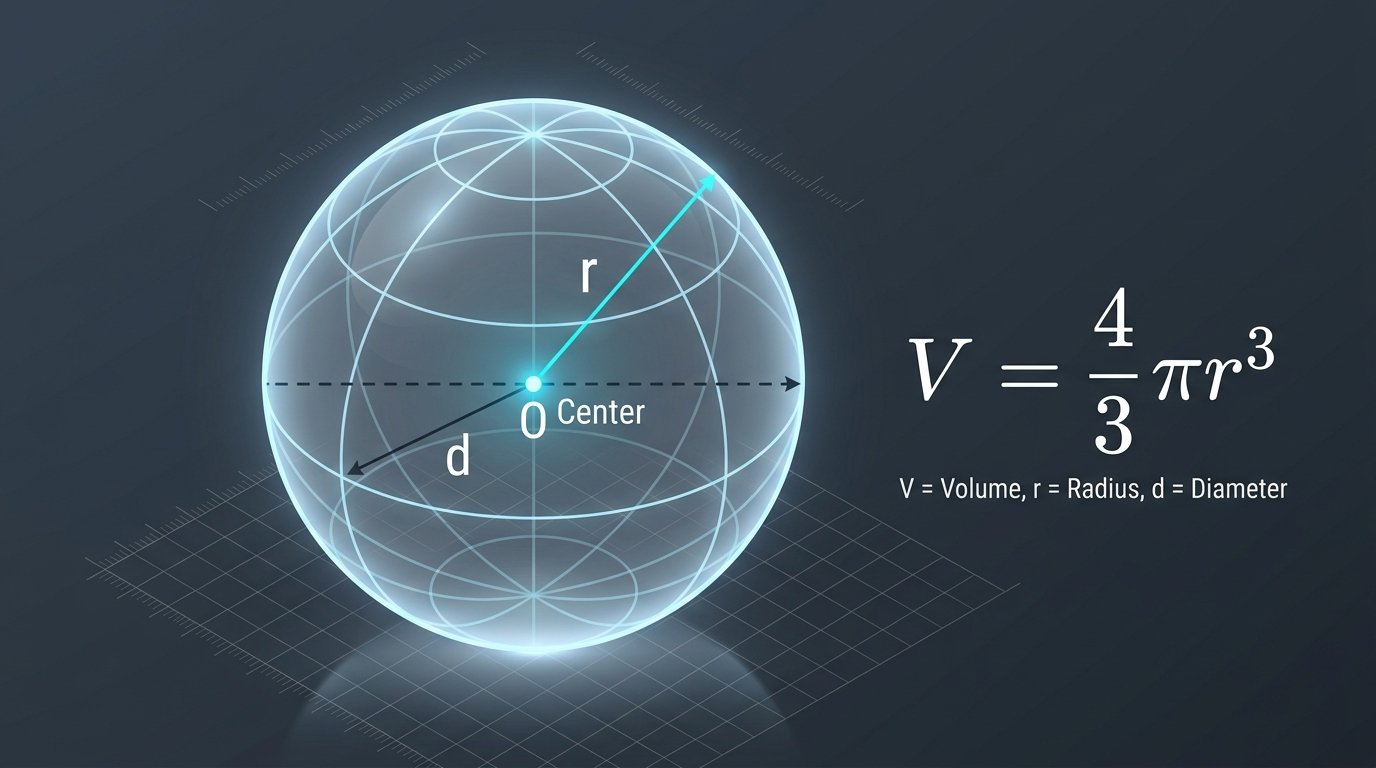
Sphere Volume Formula

Sphere Volume Formula

V = (4/3) × π × r³
Where V = Volume • r = Radius • π ≈ 3.14159265

Essential Mathematical Notation

  • V Volume of the sphere — The three-dimensional space enclosed within the spherical surface, measured in cubic units (e.g., cm³, m³, in³, ft³).
  • r Radius of the sphere — The straight-line distance from the exact center to any point on the outer surface (r = d / 2).
  • π Pi (π) — The mathematical circle constant, approximately 3.14159265 (or 22/7).
  • 4/3 Geometric Constant (4/3) — The rational coefficient derived from spherical calculus integration.
  • r³ Radius Cubed (r³) — The radius multiplied by itself three times (r × r × r), measuring 3D volume.
📂 Topic Archive: Sphere Volume Category →
Sphere Volume Formula →